How to Choose Solar LED Street Lights Wattage | Engineering Guide
Determining the precise power rating (wattage) for a solar LED street lights requires moving past generic assumptions and applying lighting engineering principles. Illumination requirements are dictated by the geometry of the thoroughfare, the designated lighting class, and the luminous efficacy of the fixture.
Deciding Solar LED Street Lights Power
You cannot choose a wattage in a vacuum. The power value of a solar LED street light is dictated by the geometry of the road, the required lighting class, and the efficiency of the luminaire.
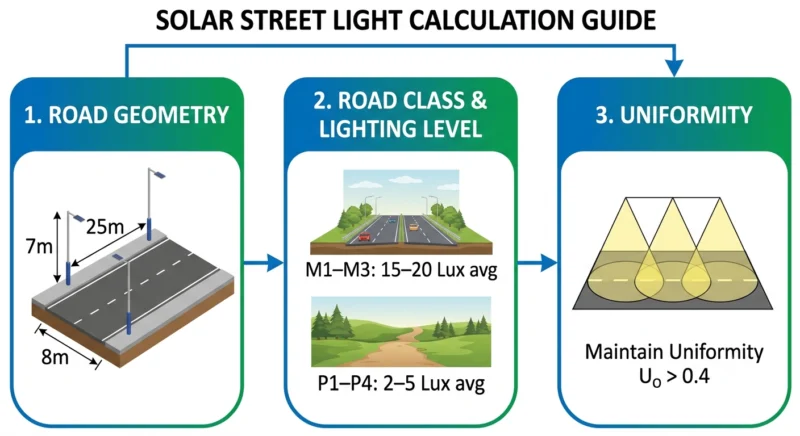
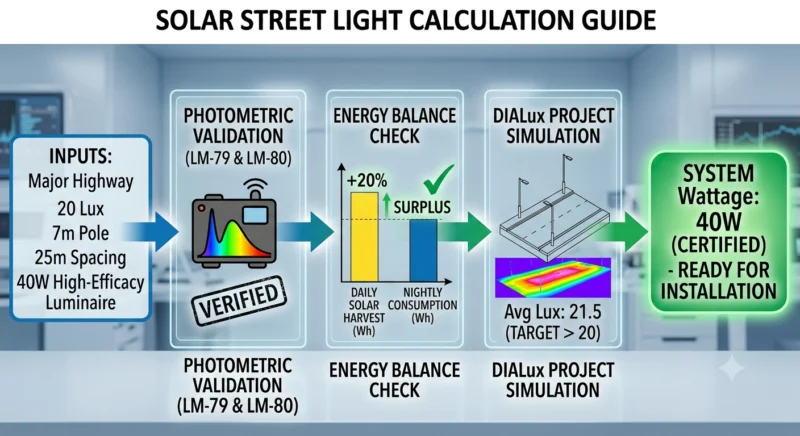
Step 1: Establish the Illumination Class and Target Lux Levels
Consult regional or international standards (such as EN 13201 or local municipal codes) to identify the required average illuminance (Lux) and uniformity ratio for the roadway:
-
Principal Arterials and Multi-Lane Highways (M1–M3): Typically demand 15 to 20 Lux average on the horizontal ground plane.
-
Collector Roads and Urban Streets (M4–M5): Generally require 7 to 10 Lux average.
-
Local Access Roads and Pedestrian Pathways (P1–P4): Usually require 2 to 5 Lux average.
Step 2: Calculate Required Lumens and System Wattage
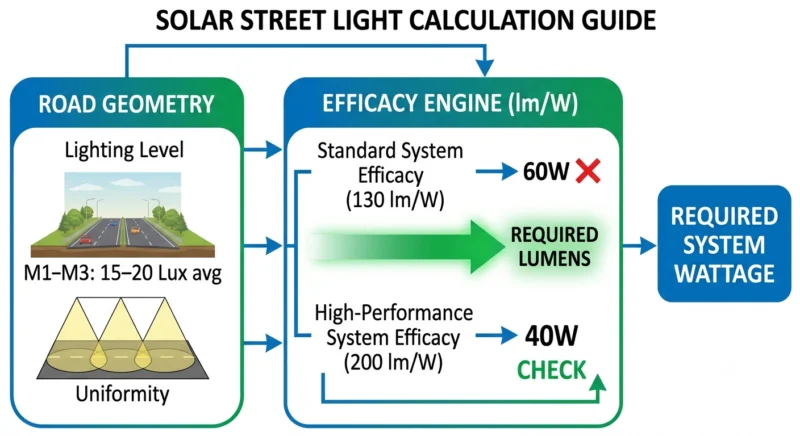
Modern high-performance fixtures deliver exceptional luminous efficacy—typically 190 to 220 lumens per watt. Consequently, calculating required electrical power involves working backward from the photometrics rather than selecting an arbitrary wattage.
First, determine total required luminous flux:
Next, divide by the system efficacy to determine the true electrical power draw:
-
Application Benchmark: A high-efficiency 30W to 40W fixture producing 190 to 220 lm/W deployed on a standard pole spacing of 25 meters provides equivalent ground lux to legacy 100W grid-tied HPS fixtures. Multi-lane highway applications on taller poles (8 to 10 meters) generally necessitate 60W to 100W systems, carefully coordinated with a smart dimming schedule.
Step 3: Verify the Solar Energy Balance
A high power value is useless if the energy storage and generation capacity cannot sustain it. The daily solar energy harvest must comfortably exceed the nightly consumption:
If the daily harvest calculation falls short of the nightly load during minimum peak sun months, the system requires either a reduction in operating wattage via a multi-stage timer/motion sensor profile or an upgrade to the panel and LiFePO4 battery capacity.
How to Avoid
Deceptive Power Specifications in the Market
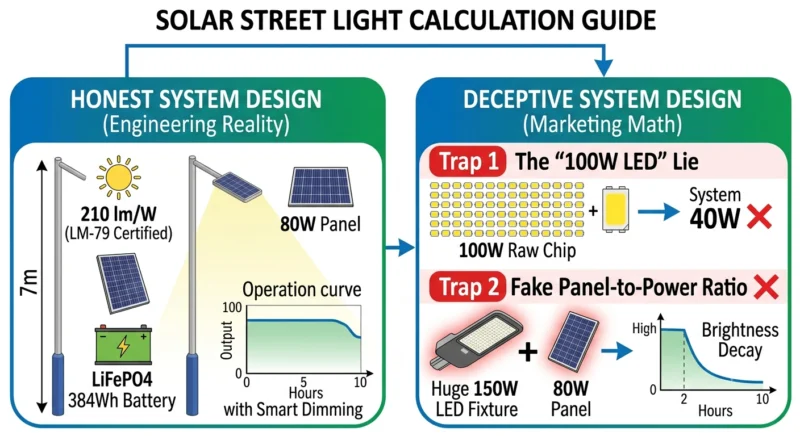
The solar LED lighting market is filled with exaggerated or misleading technical sheets. Unscrupulous suppliers manipulate numbers to make cheap components look high-end. Watch out for these common traps:
Engineering Summary:
Ready to make the smart choice for your solar powered LED street lights?
When evaluating power values, always treat the datasheet as a claim requiring proof. Require a DIALux simulation for your specific project layout, demand LM79/80 and IEC 62722 test receipts, and ensure the system wattage matches a realistic solar-harvest capacity.
Illuminate your world, the intelligent and sustainable way, right here!
Choose the smart, flexible, and reliable solution for public works, private roads, or commercial properties. Choose the suitable power of intelligent solar LED street lights.